 by
by 
The Great Blue Hole is a near-perfect circular marine sinkhole off the coast of Belize, roughly 300 meters (about 1,000 feet) wide and 124 meters (407 feet) deep. Sitting at the center of Lighthouse Reef Atoll and part of a UNESCO World Heritage Site, it was made globally famous by Jacques Cousteau. Most travelers experience it by scenic flight or full-day dive trip.
Key Takeaways
- The Great Blue Hole is a collapsed limestone cave system that flooded when sea levels rose after the last ice age.
- It lies about 70 km (43 miles) offshore at Lighthouse Reef Atoll, within Belize's UNESCO-listed Barrier Reef Reserve System.
- Diving it is an advanced experience, reaching roughly 40 meters (130 feet) past ancient stalactites and reef sharks.
- The iconic view is aerial: a scenic flight from San Pedro or Belize City reveals its deep-blue circle from above.
- Costs range from about $230-$300 for flights to $300-$400+ for full-day dive trips.
What Is the Great Blue Hole?
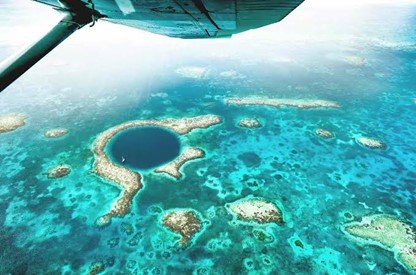
The Great Blue Hole is a giant ocean sinkhole, or "blue hole," at the heart of Lighthouse Reef Atoll, one of Belize's three offshore coral atolls. From above it appears as a startlingly dark blue circle surrounded by the pale turquoise shallows of the reef.
Its measurements are impressive: approximately 300-318 meters across and 124 meters (407 feet) deep, according to survey data cited by Wikipedia and NASA. It sits about 70 km (43 miles) from Belize City, making it a genuine open-water destination rather than a coastal stop.
The site forms part of the Belize Barrier Reef Reserve System, a UNESCO World Heritage Site. Underwater explorer Jacques Cousteau brought his research vessel Calypso here in 1971, charting its depths and later naming it one of the world's top scuba destinations. That endorsement cemented the Blue Hole as a bucket-list icon.
How Did the Great Blue Hole Form?
The Great Blue Hole was not always underwater. During the ice ages, when global sea levels were far lower, this area was dry land. Rainwater slowly dissolved the soft limestone bedrock, carving out a vast cave system.
Over time, the roof of the cavern collapsed, leaving a deep vertical shaft. As the last ice age ended and glaciers melted, rising seas flooded the sinkhole, creating the water-filled feature we see today.
The evidence is preserved inside. Divers and researchers have found stalactites hanging from the submerged cave walls, some tilted at angles that reveal ancient geological shifting. Analysis of these formations points to distinct growth phases roughly 153,000, 66,000, 60,000, and 15,000 years ago, offering a natural timeline of the last ice age.
What Do You See When Diving the Great Blue Hole?
Diving the Great Blue Hole is a bucket-list experience, but it is an advanced dive, not a casual reef swim. Operators typically require an Advanced Open Water certification, and beginners are strongly discouraged from attempting it.
Here is what a typical descent offers:
- Depth: Divers usually reach about 40 meters (130 feet), the recommended limit for recreational advanced divers.
- Stalactites: At depth, huge stalactites emerge from the cave walls, dramatic remnants of the dry-cave era.
- Sharks: Caribbean reef sharks are commonly seen circling the divers, and occasional larger species pass through.
- The abyss: Below roughly 90 meters (300 feet), the water becomes oxygen-starved and largely lifeless, a haunting, mysterious void.
It is worth setting expectations. The Blue Hole has fewer fish and corals than the surrounding reef, so its appeal is geological drama and sheer depth rather than dense marine life. For classic reef biodiversity, see our guide to [Scuba Diving & Snorkeling in Belize](#).
How Do Most People Visit the Great Blue Hole?
Because the site is far offshore, there are two main ways to experience it, plus snorkeling nearby. The table below compares them.
| Visit Option | What You Get | Approximate Cost (USD) |
|---|---|---|
| Scenic flight | 45-60 minute flyover; the iconic aerial view; window seat | $230-$300 (fixed-wing); $500+ (helicopter) |
| Full-day dive trip | 2-3 dives, including the Blue Hole plus reef walls; boat, lunch, gear | $300-$400+ |
| Snorkel day trip | Boat trip to the atoll; snorkeling nearby reefs, not the deep hole | $180-$200 |
The Scenic Flight (the Iconic View)
The postcard image of the Great Blue Hole, that perfect deep-blue circle, is only visible from the air. Fixed-wing flights depart from San Pedro on Ambergris Caye, Caye Caulker, and Belize City, with carriers such as Tropic Air and Maya Island Air running regular tours. Every passenger gets a window seat, and pilots double as guides. It is the fastest, most accessible option and requires no swimming.
The Full-Day Dive Trip
Serious divers board a boat, often from San Pedro or a liveaboard, for a full-day, multi-dive excursion. The trip usually pairs the Blue Hole descent with two shallower dives along the vibrant walls of Lighthouse Reef, plus a lunch stop at Half Moon Caye.
Can You Snorkel Near the Great Blue Hole?
You cannot meaningfully snorkel the Great Blue Hole itself, its wonders are deep, and the surface simply shows dark water. But the surrounding atoll is superb for snorkeling.
- Half Moon Caye: A protected natural monument with excellent shallow reefs and a famous red-footed booby colony.
- The atoll walls: The reef edges of Lighthouse Reef teem with corals, turtles, and colorful fish, far richer than the hole itself.
Many day trips include these stops, making the journey rewarding even for non-divers. To plan a broader ocean itinerary, explore [The Islands & Cayes of Belize](#) and our overview of [Things to Do in Belize](#).
Who Is the Great Blue Hole Best Suited For?
- Photographers and sightseers: Choose the scenic flight for the iconic image with zero physical demands.
- Advanced divers: The full-day trip is a rite of passage, best for those comfortable at 40 meters.
- Families and casual travelers: A snorkel-and-fly combination captures the magic without deep diving.
Frequently Asked Questions
How deep is the Great Blue Hole?
The Great Blue Hole is approximately 124 meters (407 feet) deep and about 300 meters (roughly 1,000 feet) wide, forming a near-perfect circle at Lighthouse Reef Atoll.
Do you need to be a certified diver to visit?
No. Anyone can take a scenic flight over the Blue Hole. Diving inside it, however, generally requires an Advanced Open Water certification because of the depth involved.
How much does it cost to see the Great Blue Hole?
Scenic flights typically run $230-$300 per person, full-day dive trips cost $300-$400 or more, and snorkeling day trips to the atoll are around $180-$200.
How do you get to the Great Blue Hole?
It lies about 70 km offshore. Reach it by boat on a dive or snorkel trip, or by small plane on a scenic flight departing from San Pedro, Caye Caulker, or Belize City.
Is the Great Blue Hole worth visiting?
Yes. As a UNESCO-linked natural wonder famed by Jacques Cousteau, it offers a once-in-a-lifetime aerial view and, for divers, a dramatic descent past ancient stalactites and reef sharks.
When is the best time to visit?
The dry season, roughly late November through April, brings calmer seas, clearer water, and better flying conditions for viewing the Blue Hole.
Conclusion
The Great Blue Hole is one of the planet's most photographed natural wonders and the crown jewel of Belize's Caribbean coast, whether you soar over it by plane or descend into its ancient depths. It captures exactly what makes this country special: wild, world-class nature just offshore from friendly island communities.
If exploring Belize has you dreaming of putting down roots near turquoise water and easy access to sites like this, Habvia can help. Browse trusted listings across Belize and Central America on Habvia (habvia.com), and discover what living in a place like this could look like. Start with our guide to [Ambergris Caye](#), the gateway to the reef.