 by
by 
The Belize Barrier Reef is the crown jewel of the Mesoamerican Reef, the second-largest coral reef system on Earth after Australia's Great Barrier Reef and the largest in the Northern and Western Hemispheres. Stretching roughly 300 kilometers along Belize's coast, it anchors a reef network spanning Mexico, Belize, Guatemala, and Honduras. Below, we explore its marine life, atolls, the Great Blue Hole, and its UNESCO success story.
Key Takeaways
- The Mesoamerican Reef runs roughly 1,000 kilometers across four countries and is the second-largest barrier reef in the world.
- The Belize Barrier Reef Reserve System was inscribed as a UNESCO World Heritage Site in 1996 and includes seven protected zones.
- It supports more than 500 fish species, 70 species of hard coral, and endangered turtles, sharks, and manatees.
- Placed on the List of World Heritage in Danger in 2009, the reef was removed in 2018 after strong conservation reforms.
- Three atolls and the iconic Great Blue Hole make Belize one of the world's premier diving destinations.
What Is the Mesoamerican Reef?
The Mesoamerican Reef, or Mesoamerican Barrier Reef System (MBRS), is a continuous chain of coral extending roughly 1,000 kilometers (about 620 miles) through the western Caribbean.
It begins near the northern tip of Mexico's Yucatán Peninsula and runs south along the coasts of Belize, Guatemala, and Honduras, tapering off near the Bay Islands.
The Belize Barrier Reef's Central Role
Within this system, the Belize Barrier Reef is the standout feature. At around 300 kilometers, it is the longest unbroken reef in the hemisphere and draws the most divers, snorkelers, and researchers. Together, these reefs form the backbone of the region's coastal ecology and economy.
Why Is the Belize Barrier Reef a UNESCO World Heritage Site?
UNESCO inscribed the Belize Barrier Reef Reserve System as a World Heritage Site in 1996, recognizing it as an outstanding example of a nearly intact reef ecosystem. The designation protects a mosaic of offshore atolls, hundreds of sand cayes, mangrove forests, coastal lagoons, and estuaries.
The Seven Protected Zones
The World Heritage Site is made up of seven distinct protected areas:
| Protected Zone | Type |
|---|---|
| Bacalar Chico National Park & Marine Reserve | National park / marine reserve |
| Blue Hole Natural Monument | Natural monument |
| Half Moon Caye Natural Monument | Natural monument |
| South Water Caye Marine Reserve | Marine reserve |
| Glover's Reef Marine Reserve | Marine reserve |
| Laughing Bird Caye National Park | National park |
| Sapodilla Cayes Marine Reserve | Marine reserve |
From "In Danger" to Recovery
In 2009, UNESCO added the reserve system to its List of World Heritage in Danger, citing coastal development, mangrove clearing, and offshore oil exploration. Belize responded with sweeping reforms, including a nationwide moratorium on offshore oil activity and stronger mangrove protections. In 2018, UNESCO removed the reef from the danger list, hailing it as a conservation success story.
What Marine Life Lives on the Reef?
The Mesoamerican Reef is one of the most biodiverse marine ecosystems on the planet, and much of the Belize reef remains unstudied. Notable inhabitants include:
- Corals: More than 70 hard coral species and 36 soft coral species form the reef's living architecture.
- Fish: Over 500 species, including parrotfish, angelfish, groupers, and barracudas.
- Sharks and rays: Nurse sharks, reef sharks, seasonal whale sharks, and eagle rays.
- Sea turtles: Endangered hawksbill, green, and loggerhead turtles that feed, nest, and migrate here.
- Marine mammals: Bottlenose dolphins and West Indian manatees grazing the seagrass beds.
To see this life up close, plan a trip built around Scuba Diving & Snorkeling in Belize.
What Are the Atolls and the Great Blue Hole?
Belize is home to three of the four coral atolls in the Caribbean, a rarity in the Atlantic.
The Three Atolls
- Turneffe Atoll: The largest, east of Belize City, prized for flats fishing and reef walls.
- Lighthouse Reef: The easternmost atoll, home to some of the most intact coral in the region.
- Glover's Reef: A remote marine reserve with a pristine, unbroken ring of coral.
Learn more in our guide to The Atolls – Turneffe, Lighthouse & Glover's Reef.
The Great Blue Hole
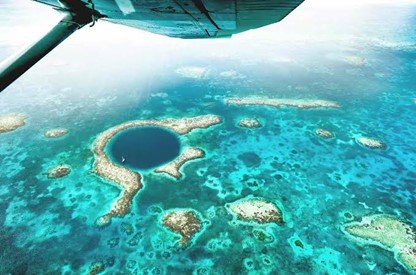
Sitting inside Lighthouse Reef, the Great Blue Hole is a near-perfect circular sinkhole about 300 meters across and 125 meters deep. Made famous by Jacques Cousteau in 1970, it is one of the most recognizable dive sites on Earth. Explore it further in our feature on The Great Blue Hole.
Why Does the Reef Matter Ecologically and Economically?
Coral reefs are among the most valuable ecosystems on the planet, and the Belize Barrier Reef delivers benefits far beyond tourism revenue.
- Coastal protection: The reef absorbs storm and hurricane wave energy, shielding shorelines from surge and erosion.
- Food security: It sustains fisheries that feed and employ thousands of families.
- Tourism: Diving, snorkeling, and reef tours drive a large share of Belize's economy.
- Carbon storage: Reef-associated mangroves and seagrass beds sequester carbon and buffer climate impacts.
What Threatens the Reef, and How Is It Protected?
Despite its resilience, the reef faces mounting pressure from natural and human sources.
Main Threats
- Climate change: Warming seas and acidification drive coral bleaching.
- Pollution: Agricultural runoff, plastics, and untreated wastewater degrade water quality.
- Overfishing: Unsustainable gear and practices deplete key fish populations.
- Coastal development: Dredging and mangrove loss remove natural buffers vital to reef health.
Conservation in Action
- Marine protected areas such as Hol Chan Marine Reserve regulate fishing and diving.
- Coral restoration projects grow and transplant coral onto degraded reef.
- Community fisheries programs give locals a role in stewardship.
- Belize's offshore oil moratorium removed a major long-term threat.
For more ways to experience this wonder responsibly, see Things to Do in Belize.
Frequently Asked Questions
Is the Belize Barrier Reef the largest reef in the world?
No. It is the largest reef in the Northern and Western Hemispheres and, as part of the Mesoamerican Reef, the second-largest barrier reef system in the world after Australia's Great Barrier Reef.
When did the Belize Barrier Reef become a UNESCO World Heritage Site?
It was inscribed in 1996. It later spent time on the List of World Heritage in Danger from 2009 until 2018, when it was removed following major conservation reforms.
How deep is the Great Blue Hole?
The Great Blue Hole is roughly 125 meters (about 410 feet) deep and around 300 meters wide, located within Lighthouse Reef atoll.
What countries does the Mesoamerican Reef span?
It runs about 1,000 kilometers through the waters of Mexico, Belize, Guatemala, and Honduras along the western Caribbean coast.
Can you snorkel the reef, or is diving required?
Both are excellent. Shallow sites such as Hol Chan Marine Reserve are ideal for snorkelers, while atolls and the Great Blue Hole reward experienced divers.
Conclusion
The Belize Barrier Reef is more than a diving bucket-list destination. It is a hemisphere-defining ecosystem that protects coastlines, feeds communities, and shelters extraordinary marine life, and its recovery proves that thoughtful stewardship works.
Dreaming of waking up near this Caribbean wonder? Browse coastal and island homes near the Belize Barrier Reef on Habvia and find your place beside the region's greatest living treasure.